White City: The Independent Little Pocket Inside Sandy You Should Know About
If you have ever driven east on 9800 South in Sandy and wondered where all those older, well-kept mid-century homes came from — the ones that look nothing like the stacked townhomes and new construction around them — you have found White City. It happens to almost everyone the first time they cross into this quiet pocket: the sudden shift in architecture, the wider lots, the sense that you have stepped into a neighborhood that has been holding its own ground for nearly seventy years. And in a way, that is exactly what White City has done.
White City is a 411-acre unincorporated island of southeast Salt Lake County completely surrounded by the incorporated city of Sandy. With a population of roughly 5,500 and a housing stock that leans heavily into the late-1950s and early-1960s, it is one of the most distinct and character-rich communities in the entire South Valley. And its story — the origin, the name, the decades-long fight to stay independent — is one of the most fascinating you will find along the Wasatch Front.
1. Why It Is Called White City (It Is Not What You Think)
The most common assumption people make is that White City was named for white houses — a tidy row of uniform white homes, like a planned company town. The real story is much more specific and personal.
In 1955, developers M. Kenneth White (who went by Ken White) and Cannon Papanicholas purchased a stretch of land in what was then unincorporated Salt Lake County and began laying out a new community. The name "White City" came directly from Ken White's surname — not from the color of the homes, not from any architectural theme, but from the man who helped envision and develop the neighborhood.
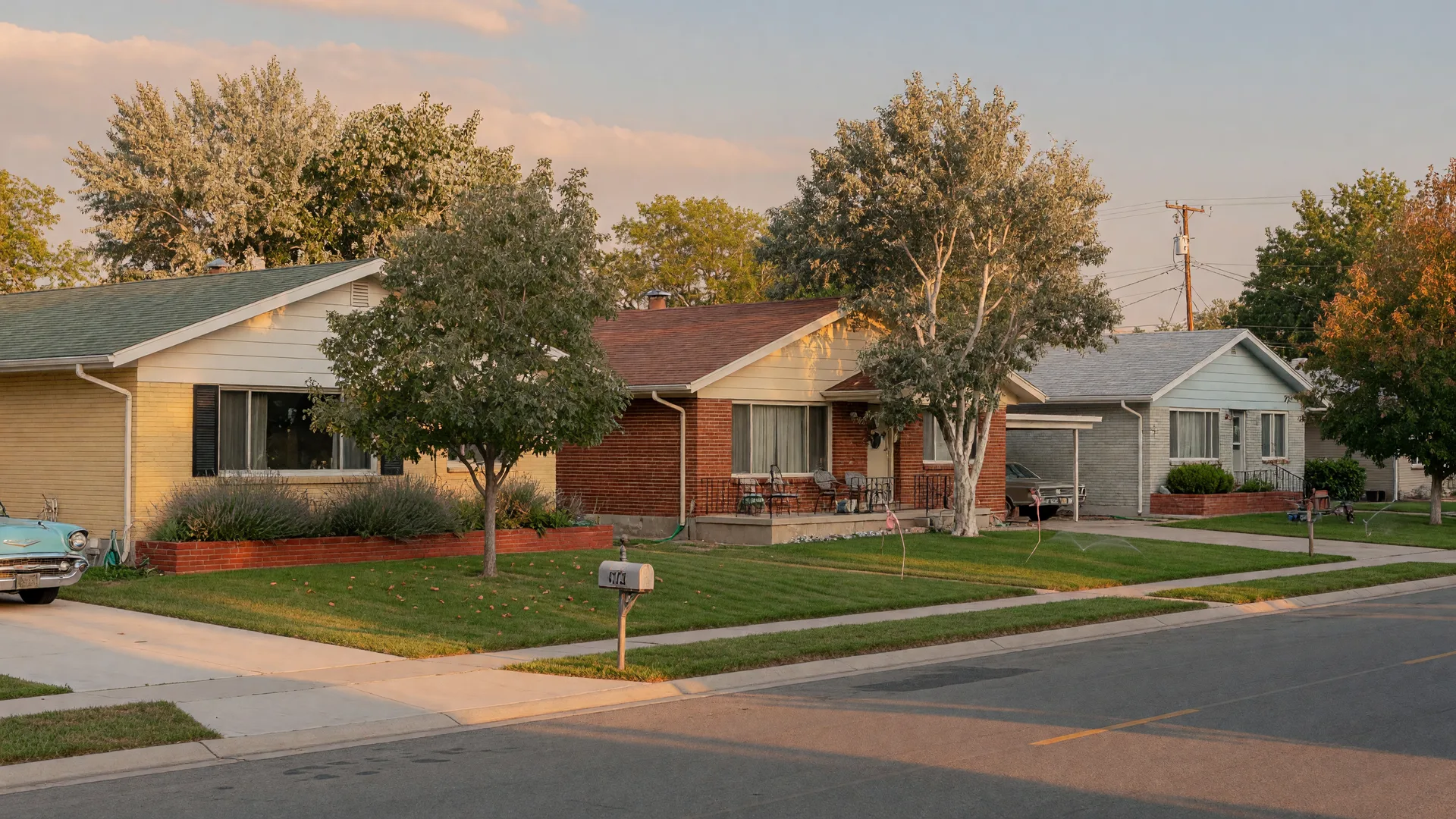
The first homes went up along Galena Drive in 1957, and the bulk of the community was built through the late 1950s and into the 1960s. The developers platted a planned grid of wide, quiet streets — Galena, Jasper, Flint, Topaz — named after minerals and gemstones, a subtle nod to Utah's mining heritage. Lot sizes were generous by today's standards, and the homes went up as solid, straightforward ranch houses and split-levels: brick and siding, attached garages, front-facing picture windows, and deep front lawns. The kind of homes that were built to last.
By the time the 1960 census rolled around, White City had become a census-designated place, recognized by the federal government as a distinct community — even though it remained unincorporated. As of May 1, 2024, it became an official Utah city, but its character and boundaries have barely shifted in sixty-plus years.
2. The Unincorporated Island That Said No to Annexation
Here is where the story gets really interesting. Since 1964 — just a few years after the last homes in the original development went up — White City residents have been actively resisting annexation by Sandy. That is more than sixty years of saying no, and that independent, tight-knit spirit is the single most defining thing about the community today.
As Sandy grew and developed into the major South Valley city it is today — with its shopping centers, new schools, and booming residential developments — White City stayed exactly where it was, a 411-acre island of unincorporated county land floating inside city limits. Residents formed a metro township in 2017 to protect their borders, and in 2024, White City officially became its own city, cementing its independence.
What does that independent streak look like in day-to-day life? For one thing, it means a different feel from the rest of Sandy. White City is not governed by Sandy City ordinances or planning departments. It has its own community council, its own water utility (originally the White City Water Company, later folded into the Sandy Suburban Service District), and its own sense of identity. Residents do not think of themselves as living in Sandy — they live in White City. And they like it that way.
This is not a neighborhood that rolled over for the big-city wave. It is a community of people who chose to preserve what they had rather than be absorbed into something else. Walk through on a summer evening, and you will see neighbors sitting on front porches, kids riding bikes on quiet dead-end streets, and a pace of life that feels more like a small town than a Salt Lake County suburb of a million people.
White City by the Numbers
3. The Housing Stock: Mid-Century Bones and Pride of Ownership
For anyone who appreciates mid-century architecture — or anyone who wants to own a piece of it without paying a premium for a "vintage" label — White City is a treasure. The community was built on a planned grid, with most homes going up between 1957 and the mid-1960s. That means the housing stock is remarkably cohesive: you will find ranch houses, split-levels, and modest two-story homes on good-sized lots, all sharing a similar era and design language.
What sets White City apart from some other mid-century neighborhoods is the pride of ownership. These are not rundown rentals or neglected properties waiting for a flipper. Many of the homes are still owner-occupied by people who have lived there for decades. The lawns are kept, the driveways are clean, and the original brick facades are maintained. It is the kind of place where neighbors care, and it shows.
For buyers, White City offers an increasingly rare combination: character and affordability. Home prices in White City trend noticeably below the rest of Sandy, making it one of the most accessible entry points into the South Valley housing market. Sandy's median home price has climbed well into the mid-to-high six figures in recent years, but White City still offers opportunities to find a home in a more reasonable range — especially if you are willing to take on updates and build equity over time.
The potential for sweat equity is real. A well-maintained 1960s ranch with original kitchens and baths, solid bones, and an unbeatable location is exactly the kind of property where thoughtful updates can add significant value. For sellers, the message is just as clear: White City's character, location, and affordability are becoming harder and harder to find in the South Valley, and buyers are paying attention.
4. Where White City Sits: Location, Access, and Nearby Amenities
One of the best things about White City is its location. The community sits roughly between 7th East and 20th East (the major north-south roads are 700 East and 1300 East through the neighborhood) and between 94th South and 106th South. That puts it in the southeast quadrant of the Salt Lake Valley, minutes from both I-15 and I-215, and extremely well connected to the rest of the region.
For commuters, the location is hard to beat. Downtown Salt Lake City is about 20 minutes north via I-15. The Silicon Slopes tech corridor in Lehi and Draper is roughly 10 to 15 minutes south. The Salt Lake International Airport is about 25 minutes northwest. The UTA TRAX light rail line runs nearby along 9400 South, providing public transit access throughout the valley. If you work in Sandy, Draper, South Jordan, or anywhere in the I-15 corridor, White City puts you in the center of everything.
Schools serving White City are part of the Canyons School District, one of the highest-rated districts in Salt Lake County. Nearby schools include Bell View Elementary, Indian Hills Middle School, and Hillcrest High School — all within a short drive. The area is also close to several private and charter options.
For everyday life, the amenities are abundant. The Dimple Dell Regional Park — a 640-acre natural-area park with hiking and equestrian trails — is just north of White City. The South Towne Center shopping district, with its retail stores, restaurants, and movie theaters, is minutes west along 10600 South. Grocery shopping, dining, healthcare, and entertainment are all within a five- to ten-minute drive. And for outdoor recreation, Big and Little Cottonwood Canyons — home to world-class skiing, hiking, and biking — are about 20 minutes east.
5. Frequently Asked Questions About White City
Is White City the same as Sandy?
No. White City is an independent community completely surrounded by Sandy. It was an unincorporated island in Salt Lake County for decades before becoming its own city in 2024. It has its own governance, its own water utility history, and a distinct identity. Residents do not pay Sandy City taxes or follow Sandy City ordinances — White City functions as its own jurisdiction.
Are all the homes in White City old?
Most are. The community was built primarily between 1957 and the mid-1960s, so the housing stock is almost entirely mid-century construction. But "old" does not mean dated here — many homes have been well maintained and thoughtfully updated by long-term owners. You will find original mid-century ranch homes that have been meticulously cared for, as well as properties that have been renovated with modern kitchens, baths, and systems. The bones are solid.
Is White City a good place to buy a home?
For buyers looking for character, space, and affordability in one of the most competitive real estate regions in Utah, White City is an excellent option. Home prices trend below the rest of Sandy, the lots are generous, and the neighborhood has genuine character and pride of ownership. For buyers willing to put in updates, there is real equity-building potential. It is also well located with easy freeway access, good schools, and nearby shopping and recreation.
What are the boundaries of White City?
White City covers about 411 acres in southeast Salt Lake County, roughly from 700 East to 1300 East (and extending toward 2000 East in parts) and from approximately 9400 South to 10600 South. It is entirely surrounded by Sandy and sits just south of Dimple Dell Regional Park, with easy access to I-15, I-215, and the 9400 South TRAX line.
6. What White City Means for Buyers and Sellers Today
In a housing market where new construction dominates and older homes are often torn down and replaced, White City represents something increasingly rare: an intact, cohesive mid-century neighborhood that has held its ground — literally and figuratively — for nearly seventy years.
For buyers, White City offers a chance to own a home with real character on a generous lot, in a location that is central to everything the South Valley offers, at a price point that is more accessible than much of the surrounding area. Whether you are a first-time buyer looking for a project, a family seeking more space and a real neighborhood feel, or an investor who recognizes the value in a well-located mid-century home, White City deserves a close look.
For sellers, White City's story is a powerful selling point. Buyers are drawn to the independence, the character, and the location. A home that is well maintained or thoughtfully updated in this neighborhood will attract interest from people who understand what makes White City different — and who are willing to pay for it.
Thinking About Buying or Selling in White City or the South Valley?
White City is one of the most unique communities along the Wasatch Front, and navigating its market requires someone who understands its character — and its value. Whether you are curious about a mid-century ranch in White City, looking to sell a home in the neighborhood, or exploring other options in Sandy, Draper, South Jordan, or anywhere along the South Valley, Adam and Natalie Stark of Stark Group Real Estate at Summit Sotheby's International Realty bring the local knowledge, market expertise, and personal attention that make a real difference.
Adam's background in finance and his SRES certification mean he can walk you through the numbers with clarity and confidence. Natalie's deep experience across Utah real estate — from historic neighborhoods to new developments — helps clients find the right fit, whether that is a mid-century fixer-upper or a move-in-ready home. Together, they make the process feel supportive, informed, and human.
Curious about White City or the South Valley market?
Call or text 801-613-0038, email info@utahcityliving.com, or schedule a consultation to talk with Adam and Natalie about what this community could mean for you.
Related Articles
Sandy Neighborhood Spotlight
Mountain gateway, Dimple Dell trails, and Canyons schools
Draper Neighborhood Spotlight
Mountain luxury, Corner Canyon, and The Point
South Jordan Neighborhood Spotlight
Daybreak, Jordan River trails, and master-planned living
First-Time Buyer Guide
Navigating the Utah housing market

Stark Group Real Estate is a leading husband-and-wife team serving Utah's Wasatch Front. Combining high-level financial intelligence with cutting-edge marketing, they deliver an incredibly supportive and top-tier experience for their clients throughout Salt Lake and Utah Counties.