
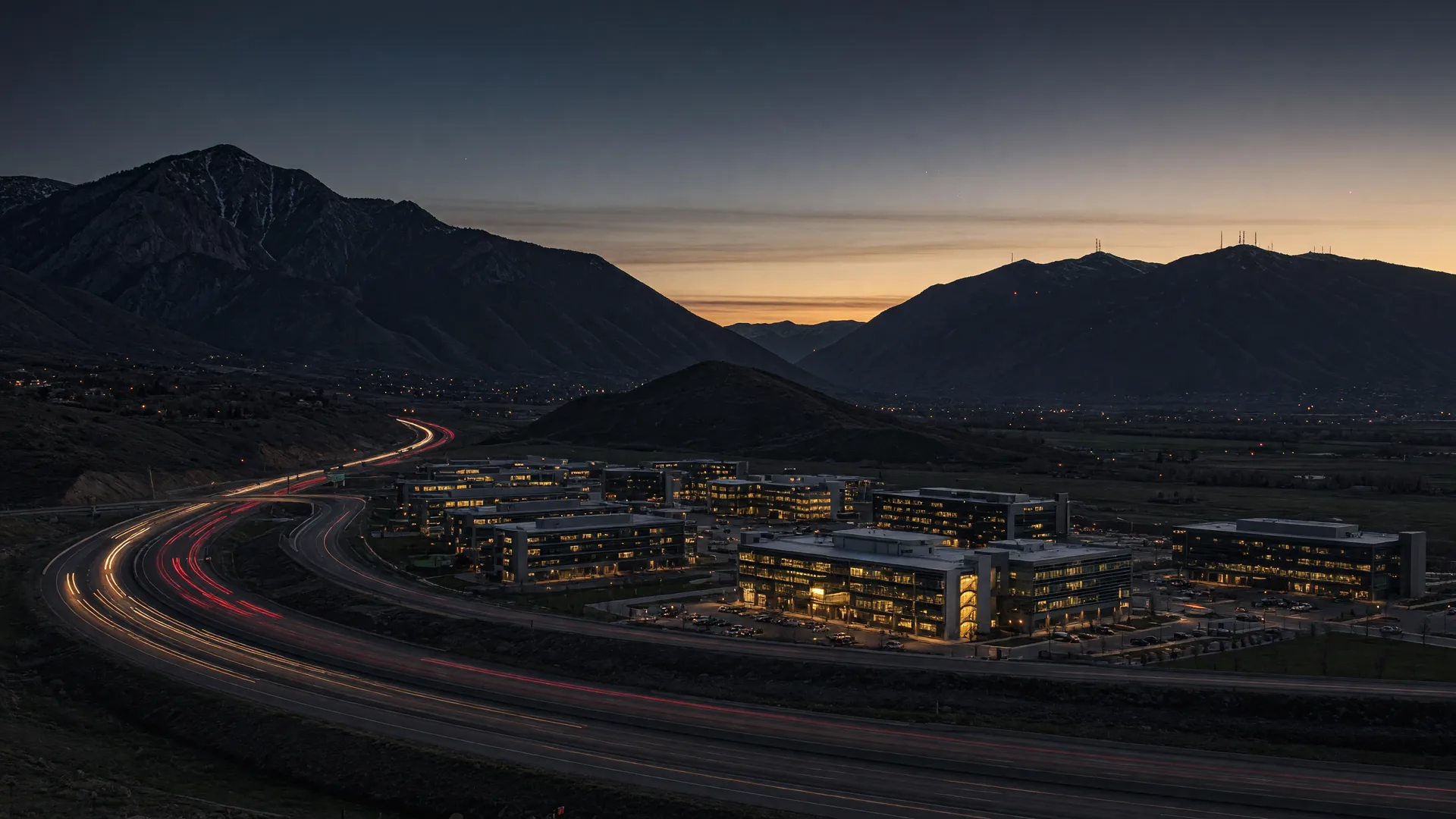
Silicon Slopes is the nickname for Utah's technology and innovation economy: a corridor of tech companies and jobs running along the I-15 freeway from roughly Provo and Lehi through Draper, Sandy, and South Jordan to Salt Lake City. The name came into use around 2014, and Silicon Slopes is also the name of the nonprofit organization that represents the region's tech community. This guide covers where the corridor runs, the major employers in each city, the kinds of jobs they hire for, how workers commute, and what the industry means for housing demand along the Wasatch Front, with each figure cited to a named source.
Silicon Slopes at a Glance
- What it is: A nickname for Utah's tech hub, dating to around 2014, and the name of the region's nonprofit industry group
- The corridor: Roughly 30 miles along I-15, from the Provo-Orem area north through Lehi and the Point of the Mountain into Draper, Sandy, South Jordan, and Salt Lake City
- Densest stretch: The Lehi-to-Draper office campuses visible from I-15, with Lehi widely described as the corridor's capital
- Transit: UTA FrontRunner commuter rail connects Ogden to Provo with 16 stations, including Lehi, Draper, and South Jordan
- Scale: The Silicon Slopes organization counts thousands of member companies; CNBC reported in December 2024 that the corridor holds more than 1,000 companies and startups
- Jobs: Utah's tech industry provided about 118,600 direct jobs in 2018, per the Kem C. Gardner Policy Institute, the most recent comprehensive published count
What is Silicon Slopes, and where does the corridor run?
"Silicon Slopes" is Utah's answer to Silicon Valley: a concentration of technology companies, startups, and jobs spread along the Wasatch Front, the band of population that runs from Ogden through Salt Lake City to Provo. The nickname came into use around 2014, and the nonprofit organization of the same name now represents the community with an annual conference, regional meetups, and local hubs. Wikipedia's Silicon Slopes overview and Provo.com's "Silicon Slopes Explained" both describe it as centered on Salt Lake City and Provo and their surrounding suburbs, which is the same ground this site covers.
The corridor runs roughly along I-15: from the Provo-Orem area in Utah County, north through Lehi and the Point of the Mountain (where the freeway crosses from Utah County into Salt Lake County), then through Draper, Sandy, and South Jordan and into Salt Lake City. Some definitions extend the corridor as far north as Ogden. The densest concentration of large office campuses, the stretch often called "Silicon Slopes proper," is the Lehi-to-Draper band visible from I-15, with Lehi described as the corridor's capital and Draper as its Salt Lake County anchor.
The corridor sits at the midpoint of the Wasatch Front's labor force, which is why employers clustered there. Workers can live in either county and commute to jobs in the middle, and the Point of the Mountain freed up land for office campuses on both sides of the county line. Utah's universities also fed the boom: Qualtrics, one of the region's best-known software companies, was founded in Provo out of Brigham Young University in 2002.
Major tech employers, city by city
Lehi: the corridor's capital
Lehi anchors the densest cluster of large office campuses. Adobe opened its Lehi campus in 2012, announced a second building in 2017 with capacity for about 1,000 additional employees, and employed roughly 1,500 people in Utah as of 2021, with company projections of about 2,300 after the expansion completed (Adobe, Utah Governor's Office of Economic Opportunity).
Lehi is also home to the headquarters of Ancestry.com; Xactware, the property-estimating software maker now part of Verisk as its Property Estimating Solutions unit, at Lehi's Traverse Parkway; Podium, the customer-messaging platform; MX Technologies, the financial data company; and Bill.com's Divvy office. Microsoft and Micron built chip-related operations at Lehi's northern edge, and Texas Instruments announced an $11 billion second fabrication plant in February 2023 expected to add about 800 jobs (FOX13 News). E-commerce company Pattern is expanding its Utah-based global headquarters with more than 500 new jobs over ten years, per the Governor's Office of Economic Opportunity (GOEO).
Provo and American Fork: the Utah County end
Qualtrics, the experience-management software company, maintains dual headquarters in Provo and Seattle and a large Salt Lake City presence. It is often grouped with Lehi's employers because it anchors the same corridor, even though its founding campus sits in Provo. Domo, the business-intelligence platform, is headquartered in American Fork, just south of Lehi.
Draper
Draper has long been Salt Lake County's Silicon Slopes hub. Pluralsight, the tech-skills learning platform, ran its worldwide headquarters in Draper for more than a decade, though in 2025 the company announced it was relocating its corporate headquarters to Westlake, Texas alongside a roughly 17% reduction of its global workforce, with Utah-based employees moving to remote work (PR Newswire, KSL). eBay runs a global customer-service center in Draper that has employed roughly 1,000 people in Utah; in 2024 the company listed its Draper campus for sale and said it planned to relocate its Utah operations within the state (Building Salt Lake). Contact-lens retailer 1-800 Contacts also keeps its headquarters in Draper.
The nonprofit Silicon Slopes organization operates a designated Sandy/Draper community hub for southern Salt Lake County professionals, a sign that the corridor's reach extends across the county line (Silicon Slopes).
Sandy
Fidelity Investments maintains a major site in Sandy, and equity-management software firm Carta has an office there. Sandy's position between Draper and Salt Lake City makes it a common home base for corridor commuters.
South Jordan
Oracle broke ground on its Utah Compute Center campus in South Jordan in 2008 and has grown it into a major operation (Deseret News). Lucid, maker of Lucidchart and Lucidspark, is based in South Jordan, and data-intelligence firm Strider announced an October 2024 expansion adding 152 jobs over five years (EDCUtah). A note on Xactware: its software headquarters is in Lehi, and Verisk has also maintained offices in South Jordan, so the company appears on both sides of the county line.
West Jordan
Just west of the core corridor, Novva Data Centers is building a roughly $1 billion, 100-acre data center campus in West Jordan; the first phase launched in 2023, and a $2 billion loan was announced in 2026 to complete phases two and three (EDCUtah, Data Center Dynamics).
Salt Lake City and The Point
Downtown Salt Lake City rounds out the corridor: Qualtrics has a large office there alongside Adobe's Salt Lake City presence, Workday and Overstock keep offices in the city, Oracle Cloud Infrastructure operates a live Utah cloud region, and financial firms including Goldman Sachs anchor the downtown economy. CNBC's December 2024 profile of the corridor noted that Silicon Slopes now holds more than 1,000 companies and startups, with Microsoft, Adobe, and Oracle among the giants with Utah operations (CNBC).
South of Draper, The Point, the redevelopment of the former state prison site at the Point of the Mountain, is planned as a mixed-use district with office space targeting life sciences, technology, and aerospace and defense tenants (The Point Utah). It is one of the largest employment-site bets in the corridor's future.
What kinds of jobs dominate?
The corridor's job mix skews to software, cloud computing, fintech, health tech, and data and AI work, layered over the professional services, sales, and operations roles every company needs. The Kem C. Gardner Policy Institute's 2019 report on Utah's tech economy, based on 2018 data, counted about 118,600 direct tech-industry jobs in the state plus roughly 50,100 tech-related jobs in aerospace, defense, and life sciences, for a combined $29.7 billion economic impact and $2.5 billion in state tax revenue. Tech supported about one in seven Utah jobs, and average tech compensation of roughly $106,000 ran more than 80% above the state average outside tech (Gardner Institute).
Growth has been consistently above national rates: Utah tech employment grew about 5% a year from 2008 to 2018, more than double the pace of the rest of Utah's economy and the second-highest ten-year tech job growth rate among all states; Utah also posted the third-fastest tech wage growth over that period (Gardner Institute). A follow-up Gardner report found Utah's engineering and computer science workforce generated roughly 230,400 jobs and $25.2 billion in GDP in 2020, with engineering employment growth outpacing the United States by more than fivefold since 2000 (Gardner Institute).
Where do the coders and data scientists actually sit? Utah Department of Workforce Services data from November 2024 shows the Provo-Orem metro has the state's highest concentration of mathematical and computer occupations (a location quotient of 1.56), followed by the Salt Lake City metro at 1.38, and the two metros together house 78% of Utah's workers in those occupations (Utah DWS). That is the Silicon Slopes story in one number: the corridor is where the state's technical talent clusters.
Commute patterns and where tech workers live
Because the jobs cluster at the midpoint of the corridor, commuting runs in both directions. Workers on the Utah County side tend to live in Provo, Orem, American Fork, Pleasant Grove, Saratoga Springs, and Lehi itself, while the Salt Lake County side draws workers from South Jordan (including Daybreak), Herriman, Riverton, Draper, Bluffdale, and Sandy. The corridor's pull on housing was visible early: the Kem C. Gardner Policy Institute found that at the height of the buildout in the mid-2010s, roughly one in six new residential units statewide was located in Lehi, Herriman, or South Jordan (Deseret News).
I-15 through the Point of the Mountain is the region's most congested stretch, and it is the bottleneck every corridor commuter knows. Typical drives run about 30 to 40 minutes from Lehi to downtown Salt Lake City and 25 to 35 minutes from Draper to downtown, while the leg from Draper south to Provo is a lighter reverse commute (Provo.com Silicon Slopes explainer).
The alternative is FrontRunner, UTA's 82-mile commuter rail line from Ogden to Provo with 16 stations including Lehi, Draper, and South Jordan. Adjacent south-valley stations are about 11 minutes apart, so Lehi to Draper is a short ride, and Draper to Salt Lake Central runs about 24 minutes. UTA's FrontRunner Forward program is double-tracking the line to add capacity and frequency (UTA FrontRunner schedule and route).
How the sector shapes housing demand
Tech jobs tend to be concentrated in a handful of cities, and so is the housing demand they create. Lehi, Draper, South Jordan (especially Daybreak), Sandy, and Herriman all sit minutes from the corridor's office campuses, which is one reason those communities have seen the region's fastest new-construction activity, from master-planned communities like Daybreak to large new developments in Herriman, Lehi, and Saratoga Springs covered elsewhere on this site.
The affordability picture for buyers is steep, and the figures this site has published from the Salt Lake Board of REALTORS Q2/Mid-Year 2026 Municipal Affordability Tracker (data via UtahRealEstate.com) put it in concrete terms. Countywide, the median-priced Salt Lake County single-family home was $645,000 in Q2 2026, requiring an estimated household income of $186,827. By city: Draper $925,000 median and $259,641 income needed, South Jordan $772,500 and $219,984, Sandy $720,000 and $206,331, and Herriman $693,900 and $199,544. The tracker's assumptions are a 10% down payment, then-current interest rates, property taxes, insurance, private mortgage insurance, and average utilities, so actual required income can run higher when HOA dues and special district fees are added (UtahRealEstate.com). Our full breakdown, Salt Lake County Housing Affordability Just Hit a Two-Year High, walks through every city in the county.
Lehi and the rest of Utah County sit outside that Salt Lake County tracker; this site's Lehi spotlight covers the Utah County side of the corridor separately. The takeaway for buyers is the same in both counties: paychecks concentrated in the corridor meet a limited supply of homes, and prices have responded accordingly.
Tech is one driver, not the only one
It is worth keeping Silicon Slopes in proportion. Utah's economy is deliberately diversified, and the state's five targeted industries are advanced manufacturing, aerospace and defense, financial services, life sciences and healthcare, and software and information technology. Together those five employed about 494,900 people and paid $41.4 billion in wages in 2024, at an average annual wage of $83,713 versus $58,059 across other industries (Utah DWS, GOEO).
Aerospace and defense are anchored by Hill Air Force Base, Utah's largest single-site employer at roughly 27,000 military, civilian, and contract personnel near Ogden. Finance and insurance remain the largest slice of state GDP at 21.9% in Q3 2024, per the Gardner Institute's 37th Economic Report to the Governor. Outdoor recreation generated $9.75 billion, about 3.3% of state GDP, and supported more than 75,000 jobs in 2024, per U.S. Bureau of Economic Analysis data reported by the Utah Office of Outdoor Recreation (Utah Office of Outdoor Recreation). Manufacturing accounts for roughly 9% of state employment, and Utah led the nation in manufacturing job growth from 2019 through 2023 at 11.8%, per Bureau of Labor Statistics data (Axios).
Tech also has cycles, and this corridor has already seen some: Pluralsight's headquarters moved to Texas in 2025, and eBay listed its Draper campus for sale in 2024. Households considering a move to the Wasatch Front should weigh the full economy, not just the tech headlines, and buyers should expect housing markets that reflect strong but not unlimited demand.
Frequently Asked Questions
What is Silicon Slopes?
Silicon Slopes is the nickname for Utah's technology and innovation economy, centered on the Wasatch Front between Salt Lake City and Provo. The name came into use around 2014 and is also the name of the nonprofit organization that represents the region's tech community, which counts thousands of member companies.
Where does the Silicon Slopes corridor run?
The corridor runs roughly along I-15 from the Provo-Orem area north through Lehi and the Point of the Mountain into Draper, Sandy, and South Jordan, and on to Salt Lake City. Some definitions extend it north to Ogden. The densest concentration of office campuses is the Lehi-to-Draper stretch visible from the freeway, with Lehi often called the corridor's capital.
Which companies are the biggest employers in Silicon Slopes?
Major employers include Adobe, Ancestry.com, Podium, MX Technologies, Xactware (Verisk), Texas Instruments, and Pattern in Lehi; Qualtrics in Provo and Salt Lake City; Pluralsight and eBay in Draper (with Pluralsight moving its headquarters to Texas in 2025); Oracle and Lucid in South Jordan; Fidelity and Carta in Sandy; Novva Data Centers in West Jordan; and Qualtrics, Adobe, Oracle, and Workday among others in Salt Lake City. Headcounts change frequently, so verify current numbers with each employer.
What kinds of jobs dominate the Silicon Slopes economy?
The job mix skews to software, cloud computing, fintech, health tech, and data and AI work, supported by sales, finance, marketing, and operations roles. The Provo-Orem and Salt Lake City metros together house 78% of Utah's workers in mathematical and computer occupations, per Utah Department of Workforce Services data, and Utah's tech industry provided about 118,600 direct jobs in 2018 per the Kem C. Gardner Policy Institute.
Where do Silicon Slopes workers live, and how long are commutes?
Because jobs cluster in the middle of the corridor, workers commute in both directions. On the Utah County side they live in Provo, Orem, American Fork, Pleasant Grove, Saratoga Springs, and Lehi; on the Salt Lake County side, in South Jordan including Daybreak, Herriman, Riverton, Draper, Bluffdale, and Sandy. Typical drives are 30 to 40 minutes from Lehi to downtown Salt Lake City and 25 to 35 minutes from Draper to downtown. UTA FrontRunner rail serves Lehi, Draper, and South Jordan as an alternative to I-15.
How does Silicon Slopes affect housing prices?
Demand concentrates in the corridor's job-adjacent communities, including Lehi, Draper, South Jordan, Sandy, and Herriman. In Q2 2026, the Salt Lake Board of REALTORS Municipal Affordability Tracker showed a countywide median single-family price of $645,000 in Salt Lake County, with Draper at $925,000, South Jordan at $772,500, Sandy at $720,000, and Herriman at $693,900, each requiring a six-figure household income under the tracker's assumptions. Figures change quarterly and Utah County is tracked separately.
Is Utah's economy entirely dependent on tech?
No. Utah's five targeted industries are advanced manufacturing, aerospace and defense, financial services, life sciences and healthcare, and software and IT; they employed about 494,900 people in 2024. Hill Air Force Base employs roughly 27,000 people, finance and insurance are the largest share of state GDP, and outdoor recreation supports more than 75,000 jobs. Tech is a major driver, but the Wasatch Front economy is deliberately diversified.
Figures change; verify before relying on them. Headcounts, job counts, salaries, commute times, and home prices in this article came from the named sources above at the time of writing and all of them move over time. Employers add, consolidate, and relocate offices, and market data is republished every quarter. Confirm current employer, job, and housing figures with the primary sources before making a decision based on them.
Thinking about living near the tech corridor?
Adam and Natalie Stark work with buyers and sellers across Lehi, Draper, South Jordan, Daybreak, Sandy, Herriman, and every other Wasatch Front community the corridor touches. Book a free 15-minute call to talk through commutes, neighborhoods, and what the current market means for your move.
Book a CallSources & Further Reading
- Wikipedia: Silicon Slopes (corridor geography and name origin)
- Provo.com: Silicon Slopes Explained
- Kem C. Gardner Policy Institute: Tech industry accounted for one in seven jobs in Utah in 2018
- Kem C. Gardner Policy Institute: Utah tech employment grows at more than twice the national rate
- Kem C. Gardner Policy Institute: Engineering and computer science workforce, 2020
- Utah Department of Workforce Services: Utah's Tech Employment (November 2024)
- Utah Department of Workforce Services: Utah's Targeted Industries
- Governor's Office of Economic Opportunity: Targeted Industries
- GOEO: Adobe to expand in Utah
- Adobe: Plans for U.S. site growth, including Lehi
- FOX13 News: Texas Instruments $11B Lehi expansion, 800 new jobs
- GOEO: Pattern to expand its Utah-based global headquarters
- PR Newswire: Pluralsight relocates corporate headquarters to Westlake, Texas
- KSL: Pluralsight moving headquarters to Texas
- Building Salt Lake: eBay looking to relocate after listing Draper office for sale
- Deseret News: Oracle facility in South Jordan
- EDCUtah: Data intelligence company (Strider) expands in South Jordan
- EDCUtah: Novva bringing major data center campus to West Jordan
- Data Center Dynamics: Novva secures $2B loan to expand West Jordan campus
- Silicon Slopes: Sandy/Draper Community hub
- CNBC: How Utah's Silicon Slopes is making a run at Silicon Valley
- Deseret News: Future of Silicon Slopes extends beyond the Point of the Mountain
- The Point Utah: redevelopment plans for the former prison site
- UTA FrontRunner: route, stations, and travel times
- Utah Office of Outdoor Recreation: outdoor recreation economy reaches $9.75B
- Axios Salt Lake City: Utah leads U.S. in manufacturing job growth (BLS data)
- UtahRealestate.com: Salt Lake Board of REALTORS Q2/Mid-Year 2026 Municipal Affordability Tracker
Employer headcounts, announced job figures, commute times, and home prices are published figures from the named sources and change over time. Verify current data with the primary sources before making decisions.
Keep Exploring
Business & Economy
Market trends and the forces shaping the Wasatch Front
Best Places to Live on the Wasatch Front
How to choose between Daybreak, Herriman, Draper & Sandy
Salt Lake County Home Values
A September 2026 snapshot of a market in balance
2026 Utah Market Update
Pricing, inventory, and trends for the Wasatch Front