When mining eventually ends at Kennecott's Bingham Canyon Mine, the pit will not simply be abandoned. Because the final excavation is far too large to fill back in, closure planning focuses on keeping the remaining landforms stable, managing water, securing hazardous areas, and monitoring the site for decades after the last truck rolls out, while the tailings facilities stay under permanent surveillance. Here is how one of the most productive mines in history got its start, what it has meant for the Salt Lake Valley, and what its future holds.
This guide is part of the Utah City Living series from Adam and Natalie Stark of Stark Group Real Estate. We cover the communities of the Wasatch Front, and Bingham Canyon sits right at the western edge of the valley we call home. When you are ready to explore the communities shaped by this landscape, we would love to help.
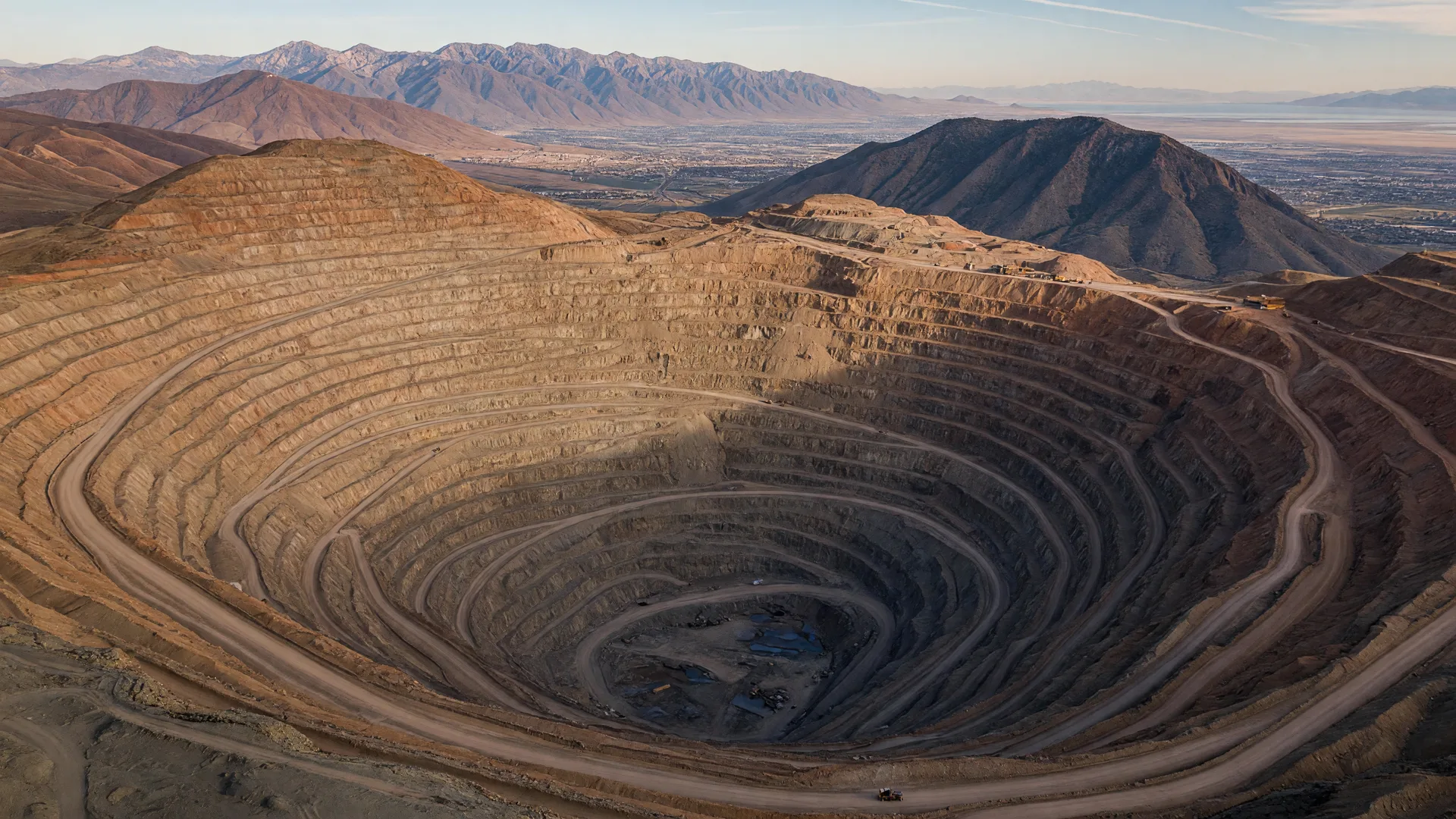
AI-generated illustration of the Bingham Canyon open pit. Not an actual photograph of the mine.
In this guide
- How did the Bingham Canyon Mine get its start?
- Why is it called the richest hole on earth?
- What has the mine meant for Utah's communities?
- What are the mine's biggest successes?
- What went wrong: the Manefay landslide of 2013
- What is the mine's environmental legacy?
- What environmental work is Kennecott doing now?
- What happens when the mining ends?
- What does the mine's future mean for Utah?
How did the Bingham Canyon Mine get its start?
Mining in Bingham Canyon dates back to the 1800s, but today's open pit has a much more specific birthday. The modern open-pit era began in 1903, when Daniel C. Jackling pioneered open-pit copper mining there. His bet was a bold one: instead of chasing rich veins underground, strip away the overburden, load low-grade ore with large mechanical steam shovels, and haul it by rail to concentrating mills. Jackling proved that ore once considered too poor to bother with could be mined profitably at enormous scale, and that idea changed mining around the world.
The Utah Copper Company was established in 1903, and the Boston Consolidated Mining Company launched operations in 1906. Together they grew into the operation the whole world would come to know. The mine has been in production ever since, a record of continuous output now spanning more than a century.
Why is it called the richest hole on earth?
The scale is hard to grasp until you see it. Bingham Canyon is the largest human-made excavation and the deepest open-pit mine in the world: about 0.75 miles (1,210 meters) deep and 2.5 miles (4 kilometers) wide. Astronauts have photographed it from space, and on a clear day its terraced walls are visible from much of the western Salt Lake Valley.
The nickname "the richest hole on earth" is earned in the ledgers. The mine has produced more copper than any mine in history, more than 19 million tons, along with significant gold and silver. In 2021 alone, the operation produced about 159,400 tons of copper, 139,500 ounces of gold, and 2.22 million ounces of silver. In 1972 the site was designated a National Historic Landmark, a recognition of both its scale and its place in industrial history.
Today the mine, concentrator, smelter, and refinery are operated by Kennecott Utah Copper, owned by the Rio Tinto Group. It remains one of the defining landmarks of the Oquirrh Mountains, the range that forms the western rim of the Salt Lake Valley.
What has the mine meant for Utah's communities?
At its peak, the operation employed more than 8,000 people and ran around the clock. Generations of immigrant workers, including a large Greek community, built their lives around the mine, its mills, and its smelters. Processing facilities spread across the valley floor in Magna, Murray, Midvale, and Tooele, and company towns grew up at the canyon mouth.
The payroll, the tax base, and the local businesses that served mining families shaped communities like West Jordan, Magna, and Copperton into the places they are today. When you drive the western side of the valley, you are driving through a landscape whose schools, neighborhoods, churches, and small businesses were built, quite literally, on copper.
What are the mine's biggest successes?
The first is technological. Jackling's method of mining low-grade ore at scale became the template for open-pit operations everywhere, and Bingham Canyon is where the template was proven. The second is economic and social: more than a century of production supplied the copper that electrified and built the American West, while sustaining thousands of jobs and the communities around them.
A third success is recognition. National Historic Landmark status in 1972 acknowledged the mine's global significance, and a century after the first steam shovel bit into the hillside, the pit remains one of the most studied industrial sites on the planet, a place where mining engineers, geologists, and visitors still come to understand how the modern world was dug out of the ground.
What went wrong: the Manefay landslide of 2013
The mine's biggest public setback came on April 10, 2013, when two massive slides carried about 145 million tons of waste rock into the pit. Known as the Manefay landslide, it is considered the largest mining-induced landslide in history, and it registered seismic events around magnitude 5.1 and 4.9. Remarkably, there were no injuries and no loss of life.
The slide buried equipment, damaged infrastructure, and interrupted production for months. It was a vivid reminder that even the most engineered industrial landscape is still a mountain, and that stability has to be earned every day. Monitoring and geotechnical work increased afterward, and the pit has continued operating since.
What is the mine's environmental legacy?
More than a century of mining, much of it predating modern environmental rules, left its mark. Waste rock dumps and tailings spread across thousands of acres, and historical contamination accumulated in ways that would not be acceptable under today's standards. That legacy is real, and Kennecott has spent decades addressing it.
Since the 1980s and 1990s, the company has worked with the EPA and Utah DEQ under a 1995 Memorandum of Understanding to clean up historical contamination under Superfund oversight. That work continues today through ongoing five-year reviews and active remediation of legacy mine waste, a long-term commitment that runs alongside, not after, production.
What environmental work is Kennecott doing now?
Reclamation at Bingham Canyon is not saved for the end of the mine's life; it has been happening for decades. More than 10,000 acres have already been restored or remediated while the operation continues around them.
A good example is the East Waste Rock Reclamation project, which reshapes waste rock, applies topsoil, and plants native vegetation. The goals are practical and visible: better erosion control, improved stormwater management, more biodiversity, and a landscape that looks like Utah again instead of a construction site.
The cleanup work with the EPA and Utah DEQ has reduced potential exposure to legacy contamination and has enabled redevelopment of large areas even while active mining continues. For suitable land, the stated end goal is to return ground to wildlife habitat, agriculture, commercial development, and, where appropriate, residential use. In other words, the valley is already beginning to get parts of itself back.
What happens when the mining ends?
Bingham Canyon will not simply be abandoned. The final pit is simply too large to fill back in, so closure planning starts from a different question: how do you make a hole this big safe and stable in perpetuity?
The answer, as outlined in Rio Tinto's planning, has several parts. First, closure focuses on ensuring the long-term stability of the remaining landforms, which means careful engineering of slopes and waste rock areas. Second, it means managing water so that runoff, groundwater, and any pit water behave predictably. Third, it means securing hazardous areas so they are safe for people and wildlife. And fourth, it means long-term monitoring after mining ends, because a site of this scale needs watchful eyes for generations.
The tailings facilities, where the rock left over from processing is stored, will require permanent management and surveillance long after mining stops. These are engineered structures with their own long lifespans, and they are part of the enduring footprint of any mine of this size.
The transition will be economic as well as environmental. The mine supports jobs, contractors, taxes, and local businesses, so surrounding communities will feel the change in their schools, their budgets, and their main streets. Rio Tinto's closure planning includes community consultation and discussions about future land use, which means residents of the Salt Lake Valley have a voice in what comes next. The future of the canyon will be shaped by the people who live beside it, not just by the company that mined it.
What does the mine's future mean for Utah?
For Utah families, Bingham Canyon is more than a sight on the way to Tooele or a backdrop in the Oquirrh foothills. It is the reason many of the valley's western communities exist. The Greek festivals, the mining neighborhoods, the mills that anchored Magna and Midvale, the schools built on mining paychecks: all of it traces back to the richest hole on earth.
The coming transition is a test of the valley's character. Reclamation is already turning waste rock into native grassland, cleanup programs are making space for new uses, and closure planning is promising that the pit will be managed, watched, and consulted over rather than left behind. If that promise holds, Bingham Canyon will become something rare: an industrial giant that helped build Utah, then helped heal its own scars, and finally helped its neighbors imagine the next chapter together.
Communities across the Oquirrh and Wasatch Front will feel that chapter, whether it brings wildlife habitat, agriculture, commercial growth, or new neighborhoods to former mine land. For anyone watching the western valley, the sunset weeks over the pit are worth a look, and so is the conversation about what comes next.
Curious About Living Along the Wasatch Front?
Whether you are drawn to the mining legacy of the western valley or the mountain communities of the east bench, Adam and Natalie Stark would love to talk. Book a free phone call and explore the communities that make Utah home.
Book a CallSources: This article is based on sourced material supplied by the Utah City Living editorial team, including Kennecott and Rio Tinto's published history, closure planning, and reclamation information; the U.S. EPA and Utah DEQ cleanup records under the 1995 Memorandum of Understanding; and National Historic Landmark documentation. Figures for mine depth, width, cumulative and 2021 production, the 2013 Manefay landslide, and reclamation acreage reflect those sources as of October 2026 and may be updated over time.
Disclaimer: This article is provided for general informational purposes only and is not legal, financial, or investment advice. The hero image is an AI-generated illustration, not a photograph of the mine. Adam Stark, Associate Broker, License 8047588-AB00, and Natalie Stark, Sales Associate, License 7369177-SA00, Summit Sotheby's International Realty, 13693 S 200 W, Suite 100, Draper, UT 84020.
Related Articles